




Metin2 Gaya Crafting Profitability
Show how material price, success input and output value determine expected crafting value.
Should You Craft or Buy? The Core Question
We all face this choice in Metin2. You see a cool item, maybe a rare upgrade material, and wonder if crafting it yourself is worth the risk. Gaya crafting adds another layer to this decision. It uses special currency and has its own success rates.
This guide will help you figure out the expected value of your Gaya crafts. We will look at material costs, the chance of success, and the final item's market price. Knowing these numbers helps you make smart choices. You can decide if crafting is a profitable gamble or if buying directly is safer.
Understanding Gaya Crafting Mechanics
Gaya crafting lets you create valuable items using Gaya, a special currency. You gather specific materials, pay a Gaya fee, and hope for a successful outcome. The catch is, success is never guaranteed. Each craft has a specific success rate.
If you succeed, you get the desired item. If you fail, you lose your materials and the Gaya fee. This randomness is why calculating expected value is so important. You need to weigh the potential gain against the consistent losses from failed attempts. It is about understanding the odds over many tries.
The Profit Formula Explained
To know if a craft is worth it, we use a simple formula. It tells you the average profit you can expect per attempt. This is called the 'expected net value'.
Let's break down what each part means. 'Success Probability' is the chance your craft will succeed. This is usually given as a percentage, like 20% or 50%. You convert this to a decimal (e.g., 20% becomes 0.20).
'Output Item Value' is how much the successfully crafted item sells for on the market. This is your potential gain. 'Material Cost' is the total cost of all items and Gaya needed for one craft. This includes the Gaya fee itself. By using this formula, you can see the long-term profitability.
Expected Net Value = (Success Probability × Output Item Value) - Material CostGathering Your Data: Market Prices and Rates
Accurate numbers are key for a good calculation. First, find the current market price for all required materials. This includes any specific items and the Gaya cost itself. Check the market regularly, as prices can change fast.
Next, determine the market value of the item you want to craft. What does a successfully crafted item sell for? This is your 'Output Item Value'. Finally, you need the 'Success Probability'. This rate is often fixed by the game for specific crafts. You might find it on the official Metin2 wiki or through in-game testing by the community. Always use the most reliable source you can find.
For this guide, we will use assumed rates and prices. These are examples to show the calculation process. Always verify current values on your server.
A Practical Example: Crafting a Legendary Soul Stone
Let's walk through an example. Imagine you want to craft a 'Legendary Soul Stone'. This is a hypothetical item for demonstration.
Here are our assumed values:
* **Required Materials:** 5x 'Soul Stone Fragment' (200,000 Yang each), 10x 'Magic Dust' (50,000 Yang each)
* **Gaya Cost per attempt:** 50 Gaya (assume 1 Gaya = 100,000 Yang for calculation)
* **Success Probability:** 20% (or 0.20)
* **Market Value of 'Legendary Soul Stone':** 150,000,000 Yang
First, calculate the total material cost per attempt:
(5 * 200,000 Yang) + (10 * 50,000 Yang) + (50 Gaya * 100,000 Yang/Gaya)
= 1,000,000 Yang + 500,000 Yang + 5,000,000 Yang
= **6,500,000 Yang** (Total Material Cost)
This means, on average, you can expect to gain 23,500,000 Yang per craft attempt. This looks like a profitable venture under these specific conditions. Remember, this is an average over many attempts. You might get lucky or unlucky on individual tries.
Expected Net Value = (Success Probability × Output Item Value) - Material Cost
Expected Net Value = (0.20 × 150,000,000 Yang) - 6,500,000 Yang
Expected Net Value = 30,000,000 Yang - 6,500,000 Yang
Expected Net Value = 23,500,000 Yang
Comparing Crafting Scenarios
The expected value changes a lot with different inputs. Let's compare a few scenarios for our 'Legendary Soul Stone' craft. We will vary the success rate and the output item's market value. The material cost will stay at 6,500,000 Yang per attempt.
This table shows how different factors impact your potential profit. It helps you see which crafts are truly worth your time and resources. We also include the 'Break-Even Output Value'. This is the minimum market price the crafted item needs to sell for to make zero profit, given the other inputs.
| Attempts | Material Spend (Yang) | Success Rate | Expected Profit (Yang) | Break-Even Output Value (Yang) |
|---|---|---|---|---|
| 1 | 6,500,000 | 20% | 23,500,000 | 32,500,000 |
| 1 | 6,500,000 | 15% | 16,000,000 | 43,333,333 |
| 1 | 6,500,000 | 25% | 31,000,000 | 26,000,000 |
Making Smart Decisions: Craft or Buy?
The expected net value helps you decide. If the expected net value is positive, crafting is generally profitable over many attempts. If it's negative, you are better off buying the item directly from the market. That extra cost is hard to justify.
Consider your risk tolerance. Crafting can be frustrating if you hit a long streak of failures. Even with a positive expected value, short-term luck can be bad. If you need the item immediately, buying it is often faster and safer. If you have plenty of materials and time, crafting might yield more profit.
Always compare the expected profit from crafting to the direct market price. Sometimes, the market price is lower than your break-even point. In those cases, buying is the clear winner. For this target, I would keep an eye on the market price of the 'Legendary Soul Stone'. If it drops below 30M Yang, I would stop crafting and just buy it.
Using StatTuner for Your Calculations
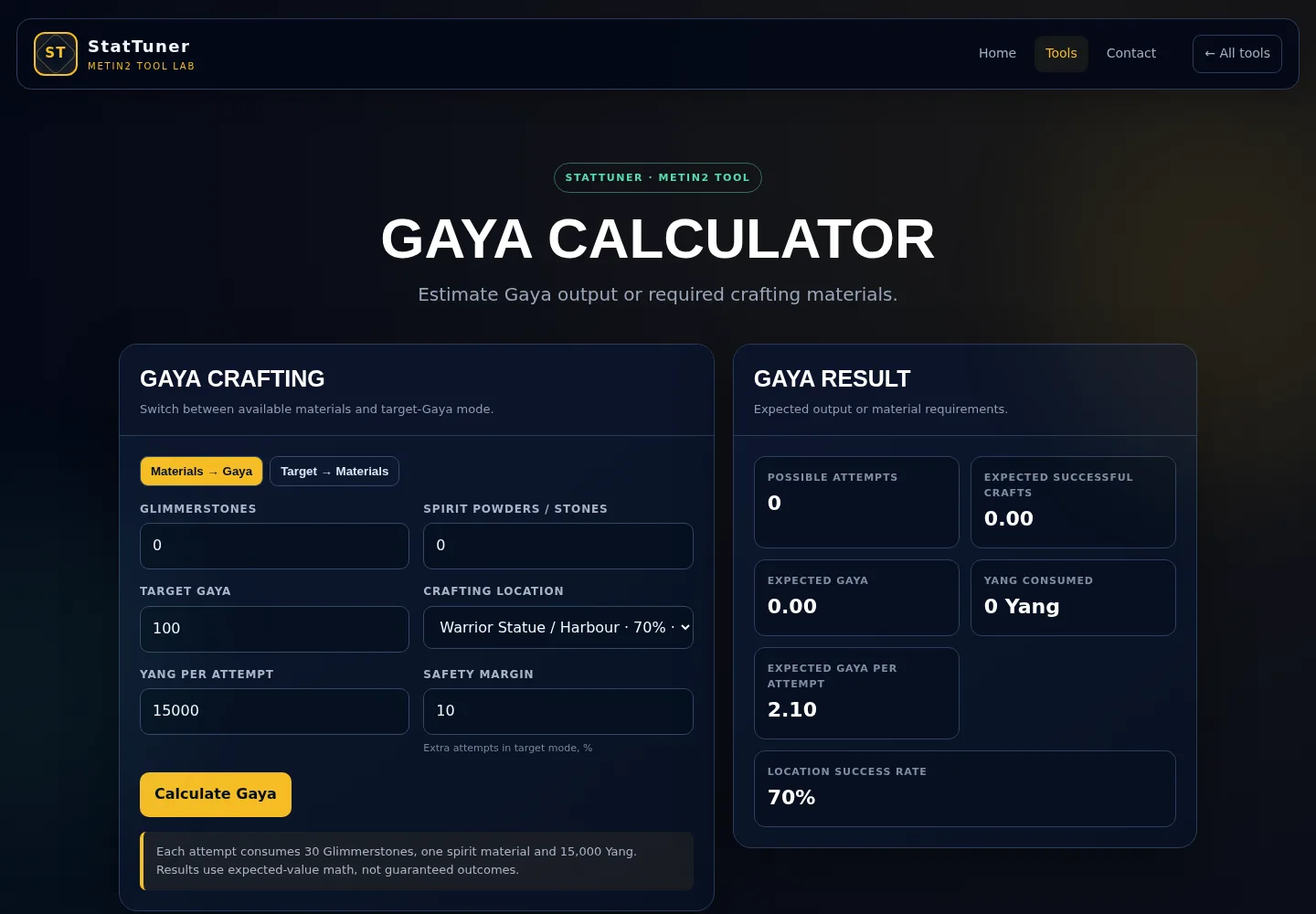
Manually calculating expected values can be tedious, especially with many different crafts. This is where tools like StatTuner come in handy. Our Metin2 Gaya Crafting Profitability tool simplifies the process. You just input your material costs, the success rate, and the output item's market value. The tool then calculates the expected net value for you instantly.
It helps you quickly compare different crafting options. You can see which crafts offer the best return on your investment. This saves you time and helps you avoid costly mistakes. Use it to check your numbers before committing to a large crafting project. It's a useful resource for any serious crafter.
Final Thoughts on Gaya Crafting
Gaya crafting can be a great way to earn Yang and get valuable gear. However, it requires a clear understanding of the numbers. Don't just craft blindly. Always calculate your expected profit before you start.
Remember that market prices and success rates can change. Regularly update your data for the most accurate results. By using the expected value formula, you turn a gamble into a calculated risk. This approach helps you build your wealth more efficiently in Metin2. Happy crafting, and may your success rates be high!
Limitations and verification notes
- Market prices and item values can change between servers.
- The calculated result is an estimate, not a guaranteed outcome.
- Game updates, events and server-specific settings may change the result.
Looking at the table, a 20% success rate with a 150M Yang output value gives a solid 23.5M Yang expected profit. However, if the success rate drops to 15%, your expected profit falls significantly to 16M Yang. This highlights how sensitive profitability is to the success chance. For the 15% success rate, the item would need to sell for over 43M Yang just to break even, assuming our material costs. If the market price for the 'Legendary Soul Stone' ever drops below 32.5M Yang, even with a 20% success rate, you would start losing money on average. I would only upgrade if the expected profit is consistently above 20M Yang, to account for market fluctuations and the risk of bad luck streaks.