



Knight Online Farm Profit After Costs
Show how party share, downtime, consumables and market tax turn gross drops into net hourly profit.
What's Your Real Hourly Profit?
You spend hours farming, collecting coins and item drops. But how much K.O. gold do you *really* make per hour? It's easy to look at gross drops and feel rich. However, many hidden costs eat into your earnings. This guide helps you calculate your true net profit. We will factor in party share, downtime, consumables, and market tax. Knowing your net profit helps you make smart farming choices.
Gross Income: The Starting Point
Your gross income is all the raw coin and item value you pick up. This is before any deductions. If you kill a monster, its coin drop goes here. Any items it drops also count towards this. We estimate the market value of these items. This gives you a total raw value. It's a good start, but not the full picture.
Effective Uptime and Party Share
You are not always fighting monsters. You stop to use potions, repair gear, or sell items. This is called downtime. Your 'effective uptime' is the actual time you spend killing. If you farm for an hour but spend 10 minutes on downtime, your uptime is 50 minutes, or 83%.
Party farming also changes things. If you are in a two-person party, you only get half the drops. This 'party share' reduces your individual gross income. We need to adjust your raw drops for both uptime and party share. This gives you a more realistic hourly gross.
Counting Your Consumables and Other Costs
Every farming session has running costs. Potions are a big one. You use HP and MP potions constantly. Attack scrolls or defense scrolls also add up. Don't forget your gear. Weapons and armor need repairs. These repair costs are part of your expenses.
Selling items on the market also costs money. The market tax takes a percentage of your sale. This tax reduces your final profit. All these small costs chip away at your earnings. Ignoring them gives you a false sense of wealth.
The Net Profit Formula
Here is the core calculation for your net hourly profit. Let's break down each part simply:
* **Adjusted Coin:** This is the total coin you pick up, reduced by your downtime and party share. If you get 100,000 coins gross, but only have 80% uptime and a 50% party share, your adjusted coin is 100,000 * 0.80 * 0.50 = 40,000 coins.
* **Adjusted Drop Value:** This is the total market value of all items you get, also reduced by downtime and party share. If your items are worth 2,000,000 coins gross, with 80% uptime and 50% party share, your adjusted drop value is 2,000,000 * 0.80 * 0.50 = 800,000 coins.
* **Consumables:** This is the total cost of all potions and scrolls you use in one hour.
* **Other Hourly Costs:** This includes your gear repair costs and any market tax from selling items, calculated per hour.
Net hourly profit = adjusted coin + adjusted drop value − consumables − other hourly costsWorked Example: Solo Farming
To illustrate how all these factors come together, let's walk through a practical example for a solo farmer over one hour. We'll use some common assumptions for drops, uptime, and costs. The detailed breakdown of inputs, calculations, and the final net profit can be found in the 'Example' section of this guide below. This example clearly shows how hidden costs reduce your gross earnings to a more realistic net profit.
Comparing Farming Strategies
Let's compare a few scenarios to see how different choices impact your net profit. These numbers are just examples. Your actual results will vary. This table shows that a higher gross doesn't always mean higher net profit. Downtime and party share are huge factors. You need to consider all costs.
* **Scenario 1 (Solo High Uptime):** This is our worked example. It shows solid profit. High uptime is key here.
* **Scenario 2 (Party of 2):** Even with higher gross drops and better uptime due to shared killing, the 50% party share significantly cuts your individual profit. The higher gross drops mean higher market tax too. I would only upgrade to a party if the *total* party drops were much higher than solo, or if solo farming was too slow.
* **Scenario 3 (Solo Low Uptime):** Even with the same gross potential as scenario 1, poor uptime and higher consumable use (perhaps due to struggling) drop profit significantly. That extra cost is hard to justify. Improving your gear or finding an easier spot would be better here.
| Scenario | Gross Income (Coin + Drops) | Effective Uptime | Party Share | Consumables | Other Costs | Net Hourly Profit |
|---|---|---|---|---|---|---|
| Solo High Uptime | 1,750,000 | 85% | 0% | 70,000 | 78,750 | 1,338,750 |
| Party of 2 (50% Share) | 2,500,000 | 90% | 50% | 60,000 | 112,500 | 1,077,500 |
| Solo Low Uptime | 1,750,000 | 70% | 0% | 80,000 | 61,250 | 1,083,750 |
Using This Knowledge
Understanding your net profit helps you make better decisions. Should you farm solo or join a party? A party might seem faster, but your individual share could be less. Is that expensive item upgrade worth it? If it lets you farm faster or with less downtime, it might pay for itself.
Always think about your effective uptime. Minimizing trips to town, using fewer potions, or killing monsters more efficiently boosts your net. Consider your build and gear. Stronger gear often means less downtime and fewer potion costs. This calculation helps you see the real value of your time.
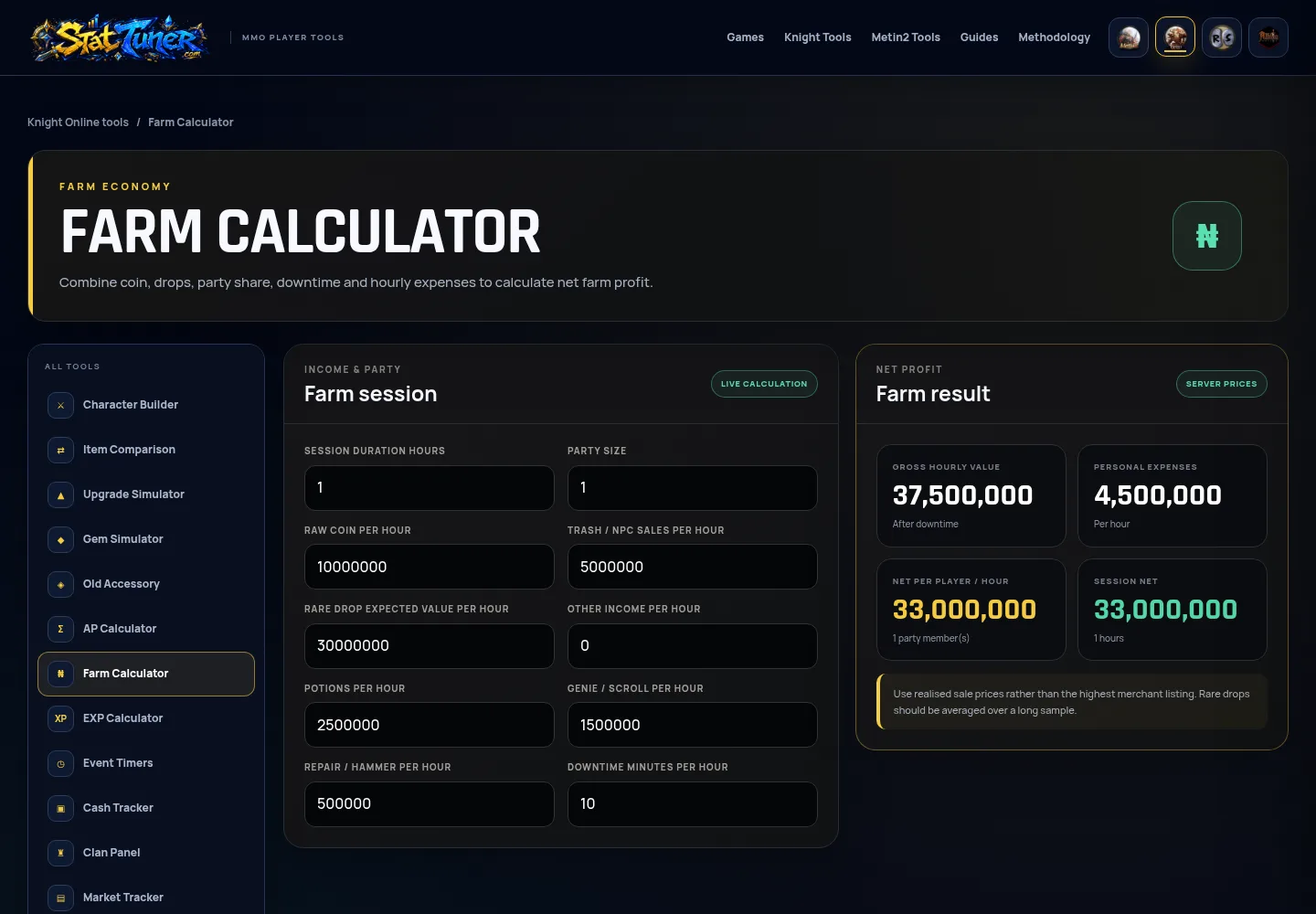
For more detailed analysis, check out the StatTuner Knight Online farm profit calculator. You can input your specific numbers there. It helps you quickly compare different farming spots or gear setups.
Limitations and verification notes
- Market prices and item values can change between servers.
- The calculated result is an estimate, not a guaranteed outcome.
- Game updates, events and server-specific settings may change the result.
This guide effectively breaks down the often-overlooked costs associated with farming in Knight Online. It clearly demonstrates how factors like downtime, party share, consumables, and market tax can drastically reduce perceived gross profits into a much lower net profit. The step-by-step example and comparison table are excellent for illustrating these concepts, helping players make more informed decisions about their farming strategies and resource management. It's a solid resource for anyone looking to optimize their gold-making efficiency.